Footsteps of History
|
|
Mission San Diego
de Alcalá |
A National
Historic Landmark
California Historic Landmark #242
City of San
Diego Historic Designation #113
The mission is an active Catholic
Parish in the Diocese of San Diego.
The California Missions began right here in San Diego with the Mission San Diego de Alcala.
Naming of the Mission:
The mission was named
for Saint Didacus of Alcala, a name given to the bay 167 years
earlier by the Spanish explorer, Sebastian Vizcaino.
Sometimes
referred to as the Mother of the Alta California Missions
Originally named
Mission San Diego Concepcion de Maria Santisima which means the
Immaculate Conception of Mary the Most Pure.
Location:
Here is a location page for the Mission
History:
From Baja California, the "Sacred Expedition" moved north in March of 1769. They divided into two groups. One came by sea and one came by land. They re-grouped in San Diego Bay in July of 1769. One of the ships had been lost at sea. Out of 159 people who left Baja California, sixty had died of medical problems. Many others were still ill and would later die. On 16 July 1769, Father Junipero Serra held Mass at the spot chosen for the first California Mission. It was at the base of a hill and near a river. A Kumeyaay village was on the hilltop. It was called Cosoy. They felt they had found a good location for their mission. There was good pasturelands nearby and the San Diego River gave them fresh water. Trees grew along the river which would help them with cooking and building. The nearby Presidio with its soldiers were a protection for the mission. The Kumeyaay were not happy with the "intruders." They heard many bad things of disease and weapons. Because of this, they resisted the missionary efforts of the padres. On 15 August 1769, the Kumeyaay charged the mission with some dying and others wounded. The local Indians soon brought their wounded to be healed by the newcomers and some inroads were made by the padres. But, the hostilities were not the only problems. The hillside land was not rich enough for growing good crops and there was either too much water or not enough. After five years, it became very difficult for the mission to continue to provide for its residents as well as for the soldiers of the presidio.
When Father Serra left to go further north, Father Luis Jayme and Father Vincent Fuster were left in charge of the struggling mission. They looked around for a new site and found one six miles up the river. They called the new site, Nuestra Senora del Pilar. It was also near a village named Nipaguay. They found good land here and fresh water. Once permission was granted for the move, they began to build a new mission in December 1774.
The Kumeyaay began to come to the mission for help and education, but only a few could live there, so many returned to their homes at night. The local village leaders were angry about the situation feeling that their traditions were being lost. Two of the converts left the mission during the night and began to travel around the area urging the people to revolt. Since the village leaders were already unhappy with the situation, there was widespread agreement. Around midnight on 5 November 5, 1775, the Kumeyaay attacked. Father Jayme came out and tried to welcome the attackers telling them his usual greeting, "Love God, my children," but the Kumeyaay were stirred up and eventually killed him that night. After two others were killed, the missions buildings were all burned. Father Jayme was the only Father to ever die in a mission attack. Originally, the Indians were to attack both the mission and the presidio, but the mission attack was earlier than planned, scaring off the presidio attackers.
After many efforts by local authorities to establish peace, Father Serra returned on 11 July 1776 with plans to re-build the mission. Some soldiers and sailors were assigned to protect the workers as well as to help them with the re-building. Finally, on 17 October 1776, the new church was dedicated. Though it was not completely finished, enough was done to allow the dedication before Father Serra had to leave. The mission church was completed on 20 March 1777.
It wasn't until July 11,
1776, with the arrival of Father Serra, did plans for rebuilding the
mission actually take place. A guard of twelve men from the Presidio
and sailors from the San Antonio were sent to protect and help with
the rebuilding. A group of California Natives greeted their return
and helped with the construction. During construction, Padre Serra
rewrote all the Mission records in his own hand. The attacks did not
continue and more converts were made. The crops and fruit trees grew
well and things settled down to a fairly good life for the
mission.
The church was enlarged in 1780. By 1785, the typical
mission quadrangle had been completed. Few additions had to be made
for many years. An aqueduct system was added in 1795. During this
time, the mission flourished with good crops, vineyards and orchards,
many converts and a peaceful setting. Once San Luis Rey and Mission
Santa Ysabel were build around the turn of the 19th
century, the padres were able to concentrate more on their local area
rather than on outlying areas. Earthquakes of 1803 and later greatly
damaged the mission. In 1808, construction again re-built the church
for the third time. The church was again dedicated on 12 November
1813 and is the mission that we see today. By 1816, the irrigation
was completed to help them through the dry seasons.
Soon after Mexico became independent in October of 1821, the missions began to be secularized. Few of the eligible Kumeyaay desired to become land owners. IN 1834, more secularization laws were passed, but this time, many illegal dealings occurred forcing the land from the Native Californians. By 1841, when Pope Gregory XVI came to San Diego, he found few people here in the town. The mission was empty and the presidio housed just a few people.
When Captain John Fremont came to the area on 29 July 1846, he used the mission as a headquarters for his group. He stayed here for fifteen years, keeping the mission up during this time. In 1862, the mission buildings and some land was returned to the Catholic Church. Though it had been returned, the mission was in terrible shape with many parts missing or in ruins. Father Antonio Ubach began to raise money to restore the mission in 1891. He worked hard, but when he died in 1907, no one carried on with what he had started. When the World's Fair was held in San Diego in 1915, the local people began to raise money to restore the mission. The Mission was finally re-dedicated on 13 September 1931. In 1941, the mission became a parish church. In 1976, Pope Paul VI designated the mission church as a Minor Basilica
The City of San Diego grew up around the mission. The mission sits on a hill overlooking the city today.
|
|
|
|
|
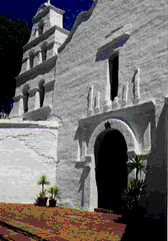
The Bell Tower at the San Diego Mission |
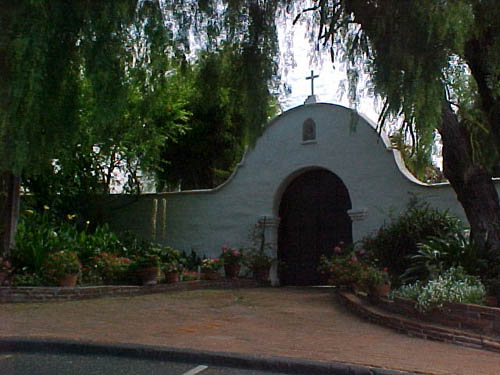
The front gate of the mission |
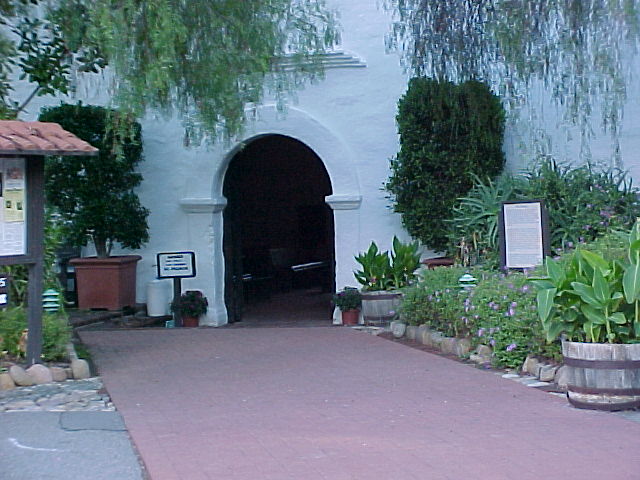
The side door of the chapel at the mission |
Contact the Mission:
10818 San Diego Mission
Road
San Diego, CA 92108-2429
Mission Links:
Official page for Mission Basilica San Diego de Acala
A history page for the San Diego Mission
More history for the mission
San Diego Mission Photo
Gallery
Mission Floor
plan and grounds
Take a virtual tour of the mission

|
Search Key to the City
|
or Search anywhere on the Web
|
Return to the Footsteps
of History California
Missions Trail home page
Return to the Footsteps of History
home
page to choose a new Trail to follow
This page was
last updated on 28 July 2012 at 11:45 pm
Key to the City is not responsible for the accuracy of the information submitted. It is the responsibility of the submitter to be sure that the information is correct and in good taste. Key to the City reserves the right to refuse publication of any item it considers improper.
Thanks for coming! Don't forget to come back soon.