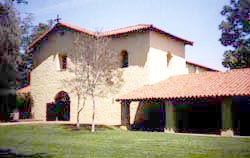
San
Fernando Rey de Espana founded
September 8, 1797 by Father Fermin Lasuen The 17th
Mission in the California Mission Chain
Naming of Mission:
The mission was named for
Saint Ferdinand III, King of Spain, (1217-1252) Sometimes known
as the Mission of the Valley. The surrounding area is often referred
to as the Valley.
Location:
The San Fernando mission
is about 22 miles from downtown Los Angeles, on Mission Drive, 1 1/2
miles west of the city of San Fernando
History:
The original intent of
this mission was to place a mission halfway between San Buenaventura
and San Gabriel. The location wound up being much closer to the San
Gabriel Mission. The San Fernando Rey de Espana mission was founded
on 8 September 1797 by Father Lasuen, one of four founded in the
same summer. The lands were rich and fertile which was good for
growing crops and raising animals. In fact, the mission became a
major supplier of food and supplies to the new Pueblo of Los
Angeles.
Within a year, the mission
had outgrown the original chapel built in 1797. A new church was
built, which was quickly outgrown and replaced in 1803. All the
mission buildings were well-built and had tile roofs. The
outstanding feature of this mission is the convento or missionary
quarters. Though all missions usually have one of these buildings,
they are usually part of the quadrangle and connected to the church.
At San Fernando, the convento was added later is was eventually two
stories high, 243 feet long and 50 feet wide. The front features 20
arches. The original buildings was finished in 1822. It was and
still is the largest adobe structure in the state. The two story
bell tower is on the patio side of the chapel. An adobe staircase
goes to the second level and choir loft. The bell tower had three
arched openings for the three mission bells.
The native people of the
area were called the Gabrielinos (Spanish name) or the Tongva,
Though the Indians at the mission were taught various trades and
skills, they were famous for their grapes and wine. The mainstay of
their economy was cattle raising, but they also had large vineyards
with vines which came from Spain. The natives were also skilled at
leatherwork and made shoes, clothing and other items from the hides
from their extensive cattle herds. The mission was also renowned for
their blacksmiths. The shop was not just for horseshoes, though that
was an important function. It was used to make all the metal tools
and things at the mission, such as utensils, grills, fences, candle
holders, brands and much more.
Because of its prominent
location, the mission became such a popular stopping place for
travelers. The convento was continually added to and was soon
referred to as the "long building" of El Camino Real.
There were often so many for breakfast that the fathers had a large
table which was built into the ceiling and lowered for meals.
Traditional meals were Atole (Corn Mush) for Breafkast, Atole along
with meat and vegetables with tortillas for lunch and more of the
same for dinner with the addition of some fruit. After dinner, there
would be singing and dancing until bedtime.
As more travelers
and visitors came to the mission, the Indian population decreased
proportionately. It became increasing difficult to keep up the
mission. After the 1812 earthquake, Father Ibarra had much trouble
making the needed repairs. He had trouble with the Mexican
government, but they allowed him to stay to keep the declining
mission under control. Finally, even Father Ibarra had to go,
leaving the mission without anyone to take care of it.
Secularization in 1834
took its toll at San Fernando just as it did at most of the
missions. Many of the roof tiles were removed by vandals which, in
turn, caused the walls to crumble from exposure to the elements.
Governor Pio Pico made the mission his headquarters in 1846. Much of
the mission land was sold after the Mexican-American War. This is
also when John C. Fremont used the mission as his headquarters.
After shiny gold particles on the roots of an onion were mistaken
for gold in 1842, the area had a gold rush of sorts. When
prospectors came to look for gold, they heard rumors of gold hidden
under the church floor. It didn't take them long to go in search of
the gold that wasn't really there. The mission was damaged even
further by this adventure.
The mission further
declined after all the roof tiles were removed except for the
convento. Later, in the late 1800's, the Butterfield Stage Lines
used the mission as a station. It was also used a storerooms for the
Porter Land and Water Company. In 1896, the quadrangle was even used
as a hog farm. Even though the mission and lands were returned to
the Catholic Church, the deterioration of the San Fernando mission
continued. In 1923, the Oblate priests arrived and the church became
a working church once again.
Various efforts to restore
the church began early on. The Landmarks Club helped to restore the
roof before the walls collapsed. They sold candles for a dollar each
and raised $6,000 to begin restoration efforts. Major restoration
did not occur until the 1940's when a monetary gift from the Hearst
Foundation was received. The convento building remains, but the
church had suffered major damaged in the 1971 Sylmar Earthquake and
had to be torn down. An exact replica was built in its place which
was completed in 1974.
Contact the Mission:
15151 San Fernando Road
Mission Hills CA 91345 Phone: 818-361-0186
Mission Trivia:
Mission San Fernando Rey
de Espana's hotel building was called the "long building"
Return to the
Footsteps of History California
Missions Trail home page Return to the Footsteps of History
home
page to choose a new Trail to follow This page was
last updated on 28 June 2012 at 11:27 pm
Key to the City is not
responsible for the accuracy of the information submitted. It is
the responsibility of the submitter to be sure that the information
is correct and in good taste. Key to the City reserves the right to
refuse publication of any item it considers improper.
All submissions become
the property of Key to the City and can not be returned.
Thanks for coming! Don't
forget to come back soon.