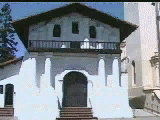
Mission San Francisco
de Asis (Mission Dolores) Founded 26 June 1776 by
Father Francisco Palóu
Naming of Mission:
The mission was named for
Saint Francis of Assisi, the founder of the Franciscan order. The
name Mission Dolores is a more common name for Mission San Francisco
de Asis.
Location:
At the intersection of
Dolores and 16th Street in San Francisco
History:
In June of 1776, Father
Francisco Palou and Lt. Jose Moraga, with a number of others,
arrived in the area. They arrived before the ship which carried most
of their supplies. But this did not stop them from commencing the
work they were sent to do, establish a new presidio and mission. The
new settlement was laid out and a site selected for the mission. The
mission site was along a small laguna, which is a little inlet,
which had been discovered the previous year during explorations. The
Laguna had been named Laguna de Nuestra Senora de los Dolores which
name became associated with the new mission. In fact, it is more
well known as Mission Dolores than as Mission San Francisco de Asis.
Though all the missions
were troubled with runaway neophytes, this mission had the worst
record. Some say it was mostly due to the weather in the area and
all the sickness it brought. Others lay blame with the mission's
proximity to the Presidio and the soldiers influence. The climate in
San Francisco was cold and damp which did not help the local
Coastonoan Indians who came to the mission. They were already
weakened by the many diseases brought in by foreigners so the chill
in the air caused many to become more sick and many died. Mission
San Rafael was built as a hospital mission in 1817, first as just an
asistencia mission to San Francisco, but later approved as a
full-fledged mission. The Indians were able to improve their health
in the newer area.
The mission moved to a
more favorable area in 1782 with a new adobe church dedicated in
1791. Father Palou left themission in 1785. The quadrangle was
finally completed in 1798. It is known as an extremely well-built
church, even withstanding the major San Francisco Earthquake of
1906. It is made of whitewashed adobe brick with a red tiled roof.
Though the front of the building appears to have many separate
columns, it is actually one single block of adobe bricks 10 feet
thick, 22 feet wide which was set on a rock foundation four feet
below the surface. It is the oldest intact building in the area.
For a time, one of the
Padres wanted to close both Mission Dolores and its asistencia, San
Rafael in favor of the new Sonoma mission, but in the end, all three
mission were kept open. The mission was not successful in growing
crops near the mission, but had to rely on land it owned almost 20
miles away. They used the crops as trade rather than to eat. The
Mission struggled during most of its active existence.
In 1834, when the missions
were secularized, Mission San Francisco de Asis was the first one to
comply. The Indians were told if they didn't return the mission and
lands would be sold to others. They didn't return, but no one wanted
to buy the land either. The mission was later used for many
non-church activities such as horse racing and gambling. Today, the
mission is still an active Parish Church with mass held regularly.
The large Basilica next door is also used for services.
Contact the Mission:
Mission San Francisco de
Asis 3321 Sixteenth Street San Francisco, CA 94114
Mailing address: 3321 -
16th Street San Francisco, CA 94114 Telephone:
415-621-8203 Fax: 415-621-2294
Mission Trivia:
the oldest intact building
in the City of San Francisco and the only intact Mission Chapel in
the chain of 21 established under the direction of Father Serra.
Registered Landmark Number
One of the City and County of San Francisco, California
Return to the
Footsteps of History California
Missions Trail home page Return to the Footsteps of History
home
page to choose a new Trail to follow This page was
last updated on 28 June 2012 at 11:22 pm
Key to the City is not
responsible for the accuracy of the information submitted. It is
the responsibility of the submitter to be sure that the information
is correct and in good taste. Key to the City reserves the right to
refuse publication of any item it considers improper.
All submissions become
the property of Key to the City and can not be returned.
Thanks for coming! Don't
forget to come back soon.