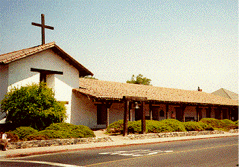
San
Francisco Solano Mission 21st
Mission State Historic Landmark Number 3
Naming of
Mission: The
mission was named after Father San Francisco Solano, a 17th century
missionary to Peru.
Location: between
Santa Rosa and Napa on State Highway 12
History:
Father
Jose Altimira at Mission Dolores in San Francisco wanted to build a
mission further north where the weather was not so damp. He thought
the Indians here were becoming sick due to this type of weather.
Many of the Indians in this area were sent to more southern missions
to help their health improve. The Father petitioned the
administrator of the missions for the founding of a new mission, but
his request was not approved. better. He felt that the poor
health of many of the Indians was caused by the foggy, damp weather.
The Governor at the time, Luis Arguello, felt that a more northern
mission would help to slow down the presence of the Russians. He was
able to influence Father Presidente Sarria to authorize the building
of this new mission. Though he first looked in the Petaluma area,
more adequate water was found in the Sonoma Valley near an
underground spring. The abundance of good water and better weather
with a longer growing season would make this a good spot for the new
mission. Father Altimira founded the San Francisco Solano mission on
4 July 1823. Other nearby missions helped with supplies at first
until the mission could become self sufficient.
The
construction was finally started in October of 1823. The Miwok
Indians came back to help with the building of the mission. They
erected a temporary chapel with logs and a thatch roof. The chapel
was dedicated on 4 April 1824. Gradually other adobe buildings were
built. Father Altimira ran the mission well, but was not good with
the local Indians. There began to be some trouble at the mission and
finally, in 1826, some of the harvest was stolen and some of the
wooden buildings were burned. Father Altimira did not feel he could
stay and asked to be transferred. He later returned to his native
Spain.
The priest chosen to
replace him was Father Buenaventura Fortuni. He was much older, but
was able to bring the mission back into harmony. By 1832, the
mission had become self-supporting and thriving. The mission
consisted of a large adobe church and a 27 room building to house
the priest and guests. There were workshops and livings quarters for
the Indians people who lived at the mission. Outside the compound,
there were many of the places which assisted the mission to
self-sufficiency, such as orchards, vineyards, a gristmill, a
cemetery and an infirmary. They had over 10,000 acres of land for
grazing and crops. The mission had 5,000 sheep and 2,000 head of
cattle. Though it was the last of the missions, it finally became
the most successful of them all.
When Father Fortuni needed
to transfer to a mission where his duties could be shared, he was
replaced in 1933 with Father Gutierrez. A short time later, in 1834,
the missions were secularized. Governor Figueroa sent General
Mariano Guadalupe Vallejo to be the area military commander and
direct the area as it changed from the Church to the public. He was
also granted 44,000 acres for his own private ranch. General Vallejo
and his group lived there at the mission for a number of years. The
town of Sonoma was also developed nearby. Foreign carpenters began
to enter the area after the Mexican government freed the ports. To
find building materials, these carpenters began to take apart the
mission with the red roof tiles being the first items to go. Only a
few rooms were left intact. When the original church fell in during
the late 1830's, a smaller chapel was built in 1841. In 1881, the
mission was sold to Solomon Schoken. The people felt the church was
too cold and damp and didn't want to meet there anymore. It was then
used as a barn, winery, blacksmith shop and hennery. Mr. Schoken
sold the mission to the California Landmarks League and in 1906, it
was donated to the state for restoration.
Several earthquakes
in the early 1900's sent the remaining buildings to the ground, but
restoration began anyway starting in 1909. The Historic Landmarks
League worked hard to make restorations. The League turned the
property over to the state when they completed their work in 1926.
Gradual restoration began over the years with much of the work
completed by the 1940's. The mission is now part of the Sonoma State
Historic Park and is listed as State Historic Landmark Number
3.
Contact the Mission:
San Francisco Solano
Mission 20 E. Spain Street Sonoma, CA 95476 Mailing
address: 114 East Spain Street Sonoma, CA 95476 Open 10:00
am-5:00 pm School Tour Reservations (707) 938-1519
Mission Trivia:
Mission
San Francisco Solano was the last of the 21 California missions to
be built.
This is the only
California mission built during the Mexican rule.
Return to the
Footsteps of History California
Missions Trail home page Return to the Footsteps of History
home
page to choose a new Trail to follow This page was
last updated on 28 June 2012 at 12:47 pm
Key to the City is not
responsible for the accuracy of the information submitted. It is the
responsibility of the submitter to be sure that the information is
correct and in good taste. Key to the City reserves the right to
refuse publication of any item it considers improper.
All submissions become the
property of Key to the City and can not be returned.
Thanks for coming! Don't
forget to come back soon.